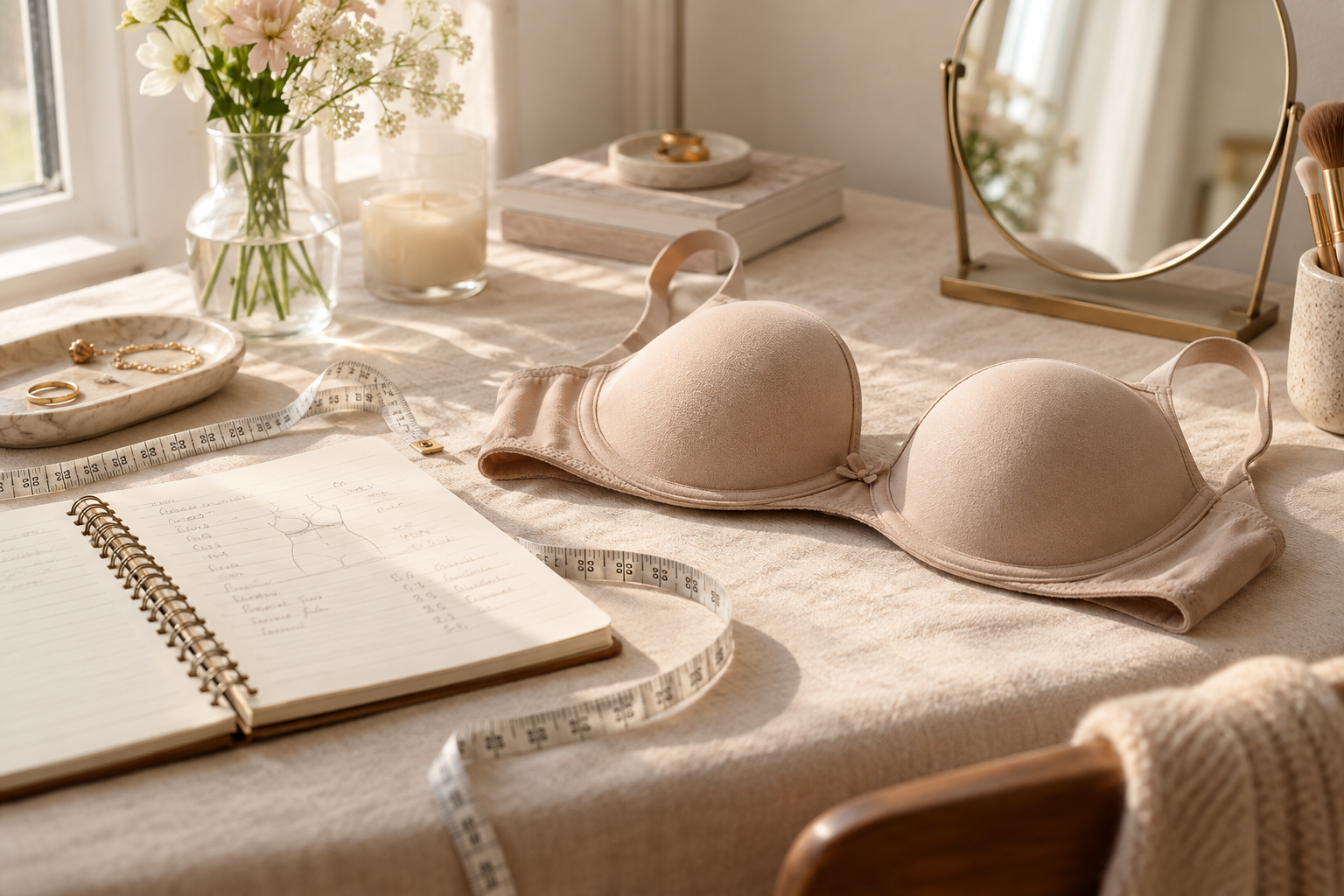
A well-fitting bra feels secure, allows you to breathe and move freely, and contains your breast tissue without pinching or spilling. The band should sit level, the cups should lie smoothly, and the straps should steady the cups rather than hold the entire weight of the bust.
The band
The underband provides much of a bra’s support. It should run horizontally around your body and stay in place when you raise your arms. A new bra should usually feel best on its loosest comfortable hook, leaving tighter hooks available as the elastic relaxes over time.
If the back rides up, the band may be too loose. If it feels sharply restrictive, leaves painful marks or makes it hard to breathe, try a larger band or a softer construction. Normal, temporary impressions are different from pain.
The cups
Settle all breast tissue into the cups before judging the fit. The cup edge should form a smooth line with no bulging, double-busting or tissue escaping beneath the band. Wrinkles or empty space can mean the cup is too large, but they can also mean the shape is wrong for you.
One breast being slightly larger is common. Fit the larger side first, then adjust the smaller side with the strap or a removable insert if you want to. Stretch lace is often forgiving of asymmetry.
The centre bridge
In most wired bras, the fabric between the cups should sit against the breastbone without pressing painfully. This is often called tacking. A very low plunge, a soft wireless style, close-set breasts or particular chest shapes can change how the centre sits, so treat it as one clue rather than the only test.
The wires
An underwire should follow the crease where the breast meets the chest. It should sit behind the breast tissue at the sides, not on it, and it should not poke the underarm or breastbone. If the cup volume seems right but the wire still feels wrong, try a different shape with wider, narrower, shorter or lower wires.
The straps
Adjust straps so they stay in place and support the top of the cup without digging. If loosening them makes the whole bra collapse, the band may not be doing enough. If straps slip even when adjusted, their placement may be too wide for your shoulders. A full-cup or centre-pull strap design can help.
A quick bra fit problem solver
| What you notice | What to try |
|---|---|
| Band rides up | A smaller band with a larger cup letter to keep similar cup volume |
| Breast tissue spills over the cup | A larger cup or a style with more coverage and depth |
| Cups gape at the top | A smaller cup, shorter cup or shape suited to less upper fullness |
| Centre floats away from the chest | A larger or deeper cup, or a lower centre if your breasts are close-set |
| Wire sits on breast tissue | A larger cup or a wire shape that better matches your breast root |
| Straps keep slipping | Re-adjust them, then try a more centred strap position if needed |
Move before you decide
Walk, sit, stretch and lift your arms. The band should remain steady and the cups should keep your breast tissue contained. Wear the bra for a few minutes while keeping its tags attached and follow the retailer’s returns instructions. A bra that only works in one carefully arranged pose is not a reliable fit.
Support should feel present, not punishing. Persistent pain, broken skin or a new breast change deserves attention beyond a different bra size.
Frequently asked questions
Should a bra leave marks?
A close-fitting garment can leave light, temporary impressions. Deep, painful or lasting marks suggest excessive pressure or an unsuitable shape.
Should the band feel tight?
It should feel firm and stable, not painful. You should be able to breathe comfortably and move without the band rolling or cutting in.
Can the right size still be the wrong bra?
Yes. Size describes volume and proportion, while the pattern determines shape. A different wire width, cup depth or strap position can transform the fit.
Find your starting size with our home measuring guide, then compare wired and non-wired bras.
Sources and further reading: Frimley Health NHS Foundation Trust, The Royal Marsden bra selection guidance, and Bravissimo’s fitting guide.